
Choosing the correct arch support for fallen arches is not straightforward. If you have fallen arches, you have probably already tried a generic insole from a pharmacy. And you might have discovered that it did nothing useful. The problem is not insoles in general. It is that most people pick the wrong type, for the wrong foot, at the wrong time. This guide will walk you through what actually matters.
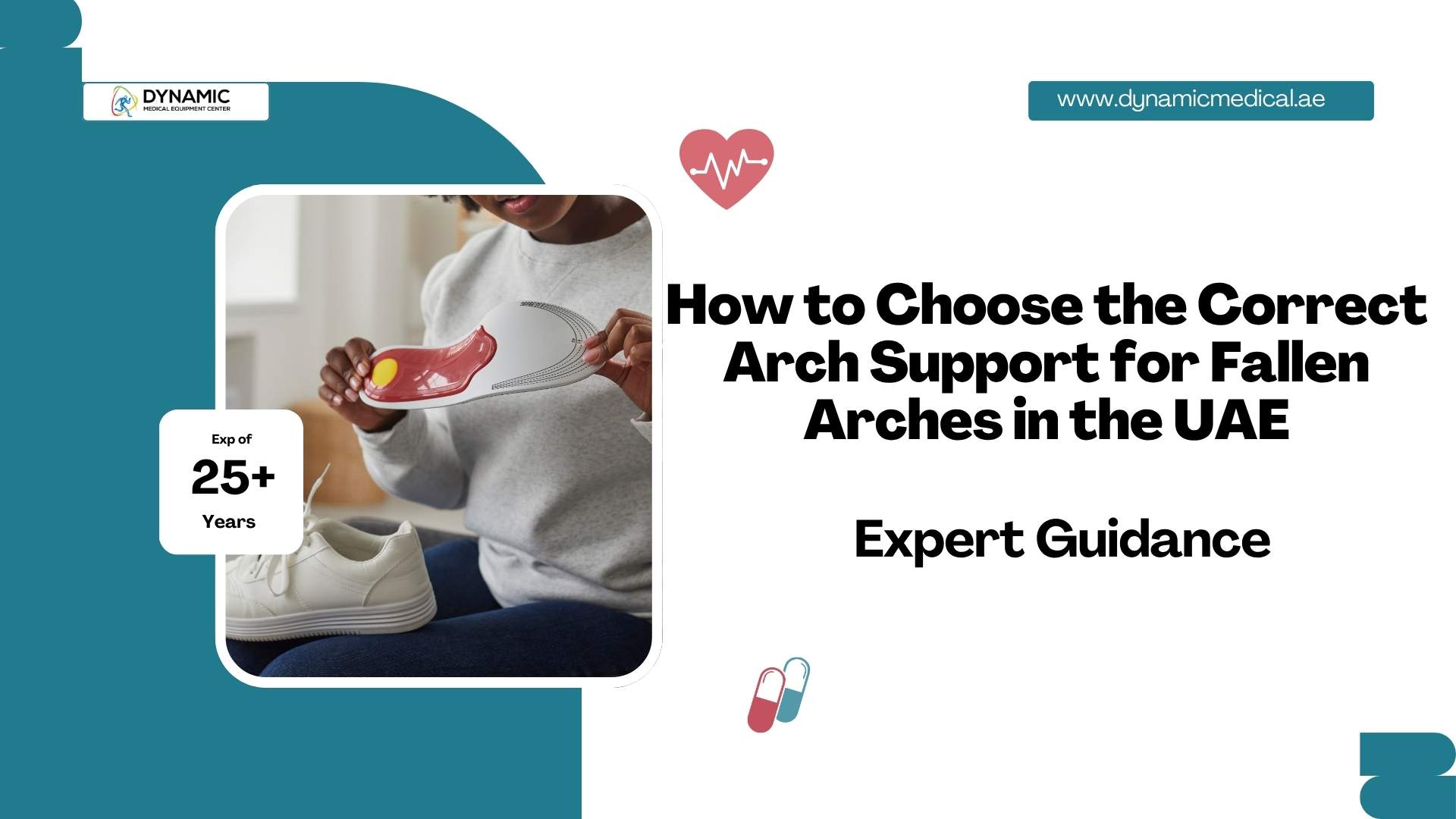
Why Fallen Arches Are So Common in the UAE
The UAE’s environment is hard on feet. Marble and tile flooring is standard in homes, offices, shopping malls, and hospitals across Dubai, Abu Dhabi, and Sharjah. Unlike carpet or wooden floors, these surfaces offer zero shock absorption. Every step transmits impact straight up through the foot, ankle, knee, and lower back.
Then there is the footwear. Sandals and flip-flops are practical in the heat. But at the same time, they offer no arch support at all. Worn daily over years, they allow the plantar fascia and the tibialis posterior tendon (the two main structures that hold the arch up) to progressively weaken. Add long hours standing or walking on hard floors in retail, hospitality, or healthcare roles, and the conditions for flat feet are almost optimal.
This is not a coincidence. It is a pattern our clinicians see repeatedly across patient populations in the UAE.
What Fallen Arches Actually Are
Fallen arches are also called flat feet or pes planus. They occur when the medial longitudinal arch of the foot collapses. It causes the sole to make full or near-full contact with the ground. The arch can fall partially or completely, in one foot or both.
There are two distinct categories. and these matter when choosing arch support:
Flexible flat feet: The arch disappears when you stand but reappears when you sit or go on tiptoe. The foot has a functional arch. It just cannot maintain it under load. This is the most common type and is highly responsive to orthotics.
Rigid flat feet: The foot has no arch whether you are weight-bearing or not. The bones themselves are in a fixed position. This is less common and this often has a structural or neurological cause. It requires a more careful clinical approach.
A 2021 review published in the Journal of Orthopaedic Surgery and Research found that adult-acquired flatfoot — the type that develops progressively in adults — is frequently linked to dysfunction of the tibialis posterior tendon. Early orthotic intervention may help slow the progression in stage I and II cases. However, results vary, and more severe presentations often require additional management beyond insoles alone.
What Arch Support For Fallen Arches Actually Does?
An arch support for Fallen Arches does not recreate your arch. That distinction is worth making clearly.
What a good orthotic does is redistribute the load across the foot, correct the alignment of the heel (calcaneus) and midfoot. A good orthotic also reduces strain on the soft tissues that are compensating for the collapsed arch. Done correctly, this relieves pain in the foot, but also secondary pain that has developed further up the chain like in the ankle, knee, hip, or lower back.
What it cannot do is reverse structural bone changes, replace torn tendons, or address neurological causes of flatfoot. If your fallen arches have a complex cause, orthotic therapy is one part of management, not the whole answer.
The Types of Arch Support For Fallen Arches — and Which One Fits Your Situation
This is where most people go wrong. They pick an insole based on the label for example “arch support — flat feet” without understanding what type of support their specific foot needs.
Rigid or Semi-Rigid Functional Orthotics
These are the most clinically effective option for adult-acquired flatfoot in people who are physically active or spend long hours on their feet. They hold the foot in a corrected position throughout the gait cycle. They control pronation and reduce load on the tibialis posterior tendon.
The limitation is that they require a specific shell fit. A semi-rigid orthotic made for an average foot may actually cause pain if your arch height, heel width, or forefoot alignment differs from the mould it was built on. This is why custom foot insoles almost always outperform off-the-shelf versions for fallen arches. The device is built from a model of your actual foot.
Soft Cushioned Arch Support for Fallen Arches
These are more appropriate for elderly patients, people with diabetic neuropathy, or those who cannot tolerate firm pressure. They absorb shock but do not provide meaningful biomechanical correction. For mild discomfort, they may help. For genuine flatfoot with overpronation, they usually do not address the root mechanics.
Medial Arch Wedges
This is a simple wedge under the arch. It is designed to support the medial column. These can help in mild cases or as a temporary measure while custom orthotics are being fabricated. On their own, for moderate-to-severe fallen arches, they are not enough.
Children’s Arch Support for Fallen Arches
Children’s flat feet deserve a separate mention. Many children have physiologically flat feet that resolve naturally before age 6. Intervening too early with rigid orthotics in a child with flexible flat feet and no symptoms is not recommended. However, children whose flatfoot is causing pain, gait asymmetry, or early wear on one side of their shoes should be assessed by a clinician rather than fitted with a generic insole.
Custom vs Generic Arch Support: What the Evidence Shows
The honest answer is that the evidence base for orthotics is better than its critics claim, but more nuanced than its advocates sometimes suggest.
A 2020 Cochrane-style review on foot orthoses for plantar heel pain (which shares much of its biomechanics with flatfoot management) found that custom orthotics and prefabricated devices produced similar short-term pain outcomes in some populations. That is worth knowing. However, for adult-acquired flatfoot specifically where tibialis posterior dysfunction is involved and the deformity is progressive, most clinical guidelines support custom functional orthotics as the appropriate device.
What generic insoles cannot do is account for your specific heel varus or valgus. Your first ray position, your forefoot alignment, or the severity and flexibility of your collapse is not accounted for in generic insoles. A custom orthotic takes all of those into account, because it is cast from your foot.
Signs You Need Professional Assessment Rather Than a Shop Insole
Some situations call for more than a trip to a pharmacy. This include the following:
- Pain that extends into the ankle, shin, knee, or lower back alongside flat feet
- Flatfoot that has appeared or worsened rapidly in one foot (this can indicate tibialis posterior tendon rupture and needs urgent evaluation)
- Foot that looks different to the other like more rolled in, heel more tilted
- Previous orthotic that did not help, or that caused pain elsewhere
- Diabetes combined with flat feet (the foot health stakes are significantly higher)
- A child over 6 who is still symptomatic
In these cases, a biomechanical assessment should come before any device is prescribed. Getting assessed properly first almost always saves time and money if you compare it with working through several ineffective insoles.
What to Expect at Dynamic Medical Equipment Centre
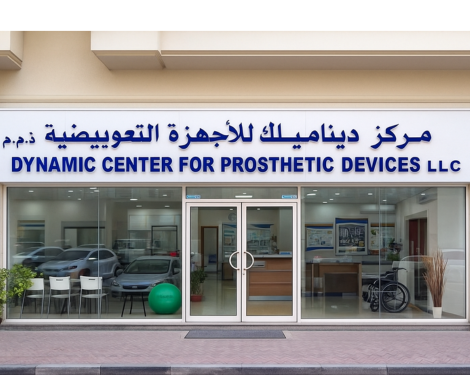
The process at Dynamic Medical is straightforward, but thorough.
Assessment first. A clinician evaluates your gait, your foot posture in stance and during walking, and the flexibility of the deformity. This determines which category of flatfoot you have and what type of orthotic is clinically indicated.
Casting or scanning. For custom orthotics, your foot is cast or scanned in the corrected position. The device is then fabricated in-house using appropriate materials. It can be carbon fibre or polypropylene for functional orthotics or softer materials for accommodative devices.
Fitting and adjustment. When the orthotic is ready, you are fitted and given guidance on how to break it in. Some adjustments are normal. Our clinicians include follow-up in the process if something is not right, it gets corrected.
Footwear guidance. An orthotic only works if it fits into appropriate footwear. We advise on shoe selection alongside the device, because the two work together.
To know more about choosing the right medical shoes read this article
Frequently Asked Questions
How do I know if I need arch support for fallen arches or something else?
Pain is the clearest indicator. Asymptomatic flat feet in adults often require no treatment. If you have pain in the foot, ankle, shin, or lower back that worsens with standing or walking, it is worth finding out whether your foot posture is contributing. A biomechanical assessment will answer that.
Can the wrong arch support make flat feet worse?
A poorly fitted or clinically inappropriate orthotic can cause secondary pain. It happens typically in the knee or hip by forcing a correction the foot cannot accommodate. It will not worsen the flatfoot structurally in most cases, but it can cause new problems. This is one reason professional fitting matters.
I tried a gel arch support from a pharmacy and it helped briefly, then stopped. Why?
Gel and foam devices compress and lose their shape over time. Many off-the-shelf supports also lack the rigidity needed to maintain correction under body weight. The relief you felt initially was probably from the mild cushioning effect, not biomechanical correction.
How do I choose the correct arch support for fallen arches if I also have diabetes?
Carefully, and with professional input. People with diabetes need devices that protect the foot from pressure points while also accommodating any neuropathy or circulation issues. A custom accommodative orthotic is usually more appropriate than a rigid functional one. Our team has experience managing foot orthotics in diabetic patients. To know about essential features of diabetic shoes in UAE read this article.
Is it worth getting arch support for flat feet if they do not hurt?
Generally, no treatment is needed for painless flat feet in adults. If you are taking up a high-impact sport or a job requiring prolonged standing on hard floors, a preventive assessment may be reasonable. But routine insoles for asymptomatic flatfoot are not evidence-based.
How long does it take before arch support starts to help?
Most patients notice some change within 2–4 weeks. Full adaptation, including any secondary pain reduction further up the kinetic chain, can take 6–12 weeks. Some adjustment of the device may be needed during this period.
A Note From Our Clinicians
Fallen arches affect a large proportion of the patients we see in Dubai, Abu Dhabi, and Sharjah. In our experience of more than 25 years, the most common mistake is choosing a device before understanding what the foot actually needs. An orthotic that corrects overpronation in one patient may be entirely wrong for another with a structurally rigid flat foot. Get assessed first. The prescription follows from the assessment, not from the label on a box.
What Sets Dynamic Medical Centre Apart
- Over 25 years of specialized orthotics and prosthetics experience across the UAE
- Custom foot insoles fabricated from advanced materials including carbon fibre and polypropylene
- Clinics in Dubai Healthcare City, Abu Dhabi, and Sharjah — accessible across the UAE
- Subsidiary of Braceman USA with offices in Chicago and Indiana
- Thorough biomechanical assessment before any device is prescribed — arch support for fallen arches is chosen based on your specific foot, not a generic profile
- Follow-up care and adjustments included; we do not hand you a product and send you home
- Daman insurance accepted
At Dynamic Medical Equipment Centre, every patient receives an individualized assessment. The devices we make are not generic products pulled from a shelf but they are designed around your specific anatomy and lifestyle. That is the difference.
Book an appointment: 📞 0525943660 🌐 dynamicmedical.ae
Explore our services: Custom Insoles & Orthotics | Medical & Diabetic Shoes | About Dynamic Medical
#arch support for fallen arches #arch support shoes #best shoes for flat feet #custom foot insoles UAE #custom insoles #custom orthotics UAE #dynamic medical centre UAE #medical shoes UAE #plantar fasciitis